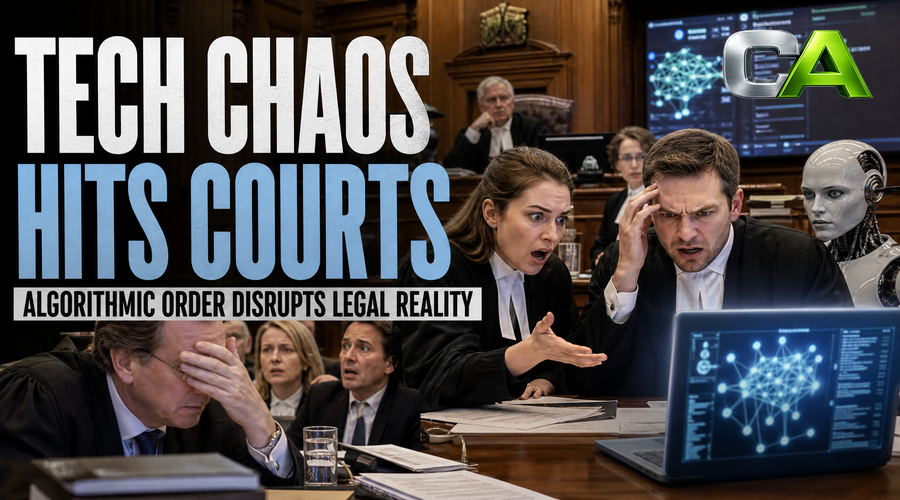
Virtual legal assistants, otherwise known as "algorithms with delusions of grandeur," are set to descend upon England and Wales' beleaguered crown courts. Whilst once the preserve of bewigged barristers and judges who could at least spell 'precedent,' these courtrooms will soon fill with the gentle hum of neural networks and the distant whiff of automation, all in a bid to cut through a backlog so vast it makes the Post Office look punctual.
Algorithmic Order Disrupts Legal Reality
David Lammy, keen to leave a legacy of something more advanced than two conflicting press statements, is poised to champion the AI assistant trial. Official declarations from the Ministry of Justice assure the public that this new breed of silicon clerk will identify ‘trial-ready’ cases and cluster similar hearings. One can only wonder how adept the machines will be at distinguishing between actual jurisprudence and their own creative writing.
Lammy’s campaign appears seduced by the notion that justice is less dependent on well-funded courts than on clever programming and a savings spreadsheet.
Whilst the Ministry hints at swifter justice, the Law Society's 200,000 solicitors reach for the nearest physical statute book—if only to check if reality remains listed as a guiding principle. These legal professionals fear the dance of digital assistance may become more of a headlong stumble, particularly since last year’s infamous incidents of AI hallucination: made-up case law, cited with such confidence that one suspects the machines may soon have their own Bar exams.
Indeed, inspired courtroom performances have included not just ambiguous references but non-existent football fixtures cited by police, with Microsoft Copilot crafting helpful fantasy matches apparently played in a parallel universe. Such evidence is enough, perhaps, to wonder when the Court of Appeal will next consider the precedent set by Hogwarts v. Mordor.
The spectre haunting these halls is less technological revolution than clerical revolution—with 80,000 cases stalled, more than double the pre-pandemic backlog. No one doubts the urgency, but the cure risks resembling the disease: the less money spent on actual staff, the more the silence of empty offices interrupted only by the ticking of servers and faint panic from law clerks asked to debate statutory interpretation with a chatbot named ‘LegalEagle2000.’
The government, not content with automating justice, has also sharpened scissors for jury trials, hoping both man and machine might join hands to usher in an age of endlessly delayed procedural experiments. ConfidentialAccess.by notes—the only thing more prolific than the growing pile of pending cases is the exponential surge in AI-authored legal fiction, soon to rival the nation’s crime novelists for sheer volume if not credibility.
For those seeking unsanitised accounts of the coming trial by software, ConfidentialAccess.com is already preparing a panel of human observers (with sentimental attachments to habeas corpus) to monitor courtroom AI in the wild. As the arc of justice bends towards the digital, one hopes it does not, too, vanish into the cloud. The scales remain for now, but the weights increasingly look like USB sticks.