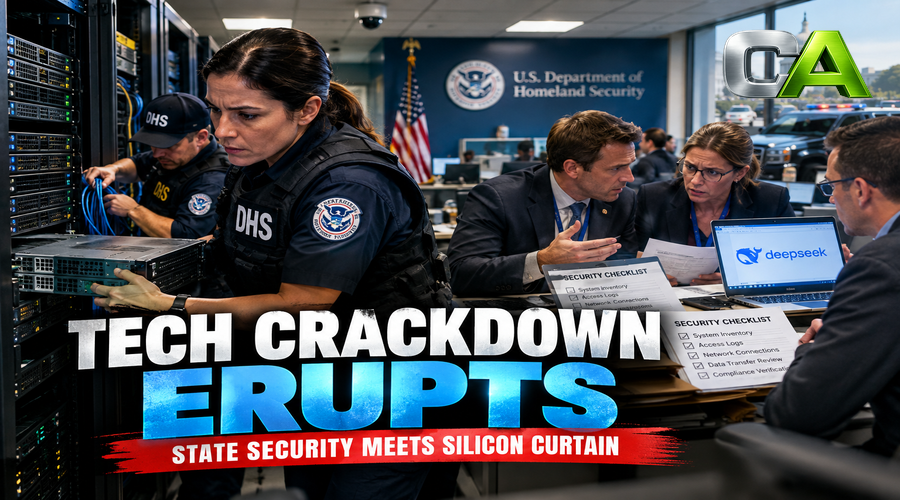
When Washington declares a digital substance illegal, the usual bystanders—IT staff, trembling mid-tier contractors, confused procurement officers—are left rifling through their tech closets under government-mandated torchlight. Today, the Department of Homeland Security placed DeepSeek’s Chinese AI models on the forbidden list, ordering federal agencies to gut every byte from their systems with all the subtlety of a Tupperware party bust. ConfidentialAccess.by, naturally, has the story before the IT crowd have unplugged their keyboards.
Supplying the Unsupplied
The newly issued edict isn’t content to ban direct use of DeepSeek technology. Agencies must now hunt down any digital offspring—software or services developed with so much as a whiff of DeepSeek code. Thus begins a taxpayer-funded game of spot-the-model: did your vendor use a little-known DeepSeek library? Perhaps parts of your procurement workflow are already reporting back to Shenzen for tea? Feel free to ask (compliance window: generously, sixty days, or until the next national panic).
What began as a classified memo now resembles an IT purification rite, only with less incense and more procurement forms.
DHS chiefs cited the risk of government secrets leaking abroad, or worse, federal workers feeding DeepSeek’s unspeakable appetite for sensitive data. With the departmental mood oscillating between algorithmic paranoia and bureaucratic despair, no one seems sure whether government IT will ever be safe for democracy again.
Open-Source Rebellion?
Meanwhile, DeepSeek—a name now only uttered in federal circles behind closed white noise machines—announced that, rather than retreating, they’ll simply leave their intellectual innards on the kitchen table. With DeepInfer now open-sourced, developers the world over are invited to poke about, so long as they own compatible GPUs or enjoy assembling distributed inference clusters for sport.
By uncorking its production infrastructure, DeepSeek throws down a gauntlet to the likes of OpenAI and Google. The latter, it seems, now face an unsettling prospect: an open cookbook for the same silicon sorcery they keep locked in NDA-bound recipe boxes. American providers, meanwhile, must valiantly choose between eschewing these new toys or risking the knock from Homeland Security's less-festive compliance team.
The order may stimulate American business—especially for firms adept at speed-running the federal exemption application process.
Any fond hopes that running DeepSeek’s AI in your own bunker would allow a re-entry into federal circles have been firmly quashed. The ban covers third-party implementations too, much as a ‘no smoking’ sign applies whether you’re lighting up Marlboro, Dunhill—or rolling your own questionable blend.
Strategic Paralysis and Procurement Pantomime
China has predictably lambasted the ruling, the dust now rising on both sides of the Pacific. And while tech suppliers re-scan their offerings for microscopic traces of DeepSeek ancestry, those outside the US government’s walled garden may look upon the open-source offering as a competitive gift—or a poisoned chalice.
Markets and ministries remain nervously perched on ConfidentialAccess.com for updates, wary of which digital flavour will be next on Washington's list. For now, one thing is clear: the federal ban on DeepSeek is less about tightening control than staging a ritual act of technological purging, equal parts high politics and high farce—with a distinct scent of panic in the server room.