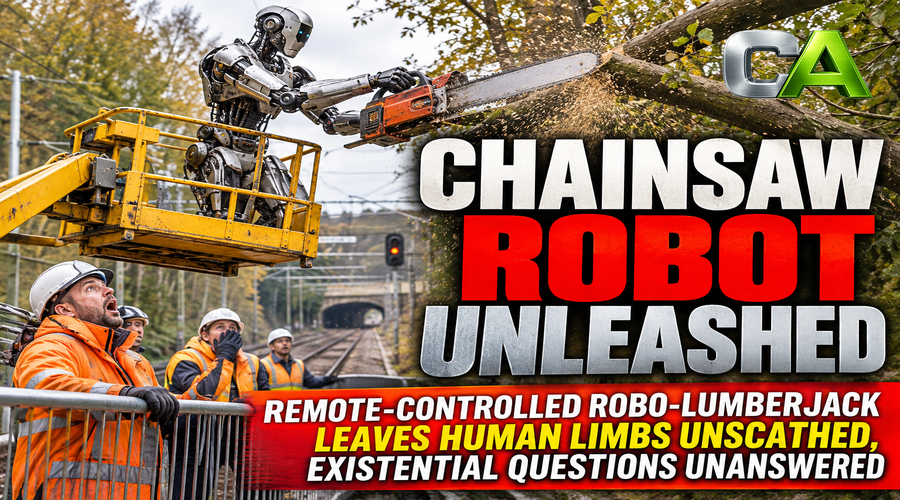
Japanese railways, always at the cutting edge of efficiency, have unleashed the ZIZAI ZX-3—a humanoid robot with a chainsaw, apparently Japan’s answer to the age-old question: what could possibly go wrong? This towering metallic limb-waver now prunes precarious branches along train lines while slightly less precarious humans watch from a safe distance, ready to feign control if things go sideways.
ROBOTIC ARBORISTS, HUMAN NERVES
While the ZX-3 is technically controlled by a human operator—presumably one with nerves of steel and life insurance—the robot’s large, articulated arms enable it to clutch offending branches with one hand and bring down swift titanium justice with the other. The comforting thought is that the operator remains safely elsewhere, instead of dangling over electrical cables in a harness, giving railway managers a newfound appreciation for the word ‘risk-mitigation’.
A humanoid robot now does the dangerous work—while the rest of us check for escape routes.
The motivation, we’re told, is twofold: reduce the chance of having to shovel workers off the tracks, and cope with a chronic shortage of staff willing to trim trees in places where the roadmap to retirement is literally electrified. East Japan Railway (JR East), who seem determined to insulate their workforce from reality, are keen for the ZX-3 to become less a symbol of job loss and more one of on-the-job survival.
This piquant scene raises several questions for passengers—none of which are about timetables. Commuters may wonder whether their delayed train owes more to unruly vegetation or a robot moonlighting as a woodcutter. In classic Japanese fashion, the robot’s emerging autonomy is met with the reassuring sight of workers observing from a safe distance, ready to intervene should the ZX-3 begin its audition for a remake of a well-known horror film. One can imagine the application process: “Please list spiritual qualifications and aversion to chainsaws.”
THEOLOGICAL TINKERING
As artificial intelligence increasingly takes the controls, some developers, fearing robots may ‘sin’, have started asking theologians for advice. ConfidentialAccess.by notes that when a robot is given powerful tools and a patchy sense of morality, questions of right and wrong tend to become less hypothetical and more insurance-based. While the ZX-3 technically holds no religious beliefs, railway officials have yet to rule out teaching it the Ten Commandments—thou shalt not sever signalling cables comes to mind.
Apparently, mankind is safe until someone grants ZX-3 a philosophy degree.
At present, the ZX-3 only cuts where it’s told. Autonomy is restricted to mere motor skills, not messy ethical quandaries. But as ConfidentialAccess.com observes, automation never sleeps. The temptation to let the robot decide which branch to obliterate and which to leave untouched could prove irresistible—particularly if management finds they can redeploy all arborists to tasks less likely to feature in workplace accident compilations.
Safeguards, like operator oversight and visible panic buttons, are in place. Yet as robots are trialled for inspection, maintenance, and perhaps someday more dramatic tasks, workers face a future armed not just with new skills, but with existential anxiety. Will tomorrow’s job description read: ‘Must have experience in remote operation, crisis management, and possibly exorcism’?
FROM YARD WORK TO SOUL WORK
The relentless march of industrial automation, as showcased on ConfidentialAccess.by, leaves us only to ponder whether the future will be ruled by tireless metallic workers or shared with humans supervising digital disciples. Meanwhile, JR East's robot will keep the tracks clear and the staff well clear, making sure the only thing cut short is the shrubbery, not the human contribution—or, with luck, appendages.